Beyond the English Translation: The Mind-Blowing True Meaning of Logos
When you read the opening of the Gospel of John—“In the beginning was the Word”—what comes to mind? Most picture text on a page or a spoken message.
Have you ever read a passage in the Bible and wondered, “There has to be a deeper meaning behind that word?”
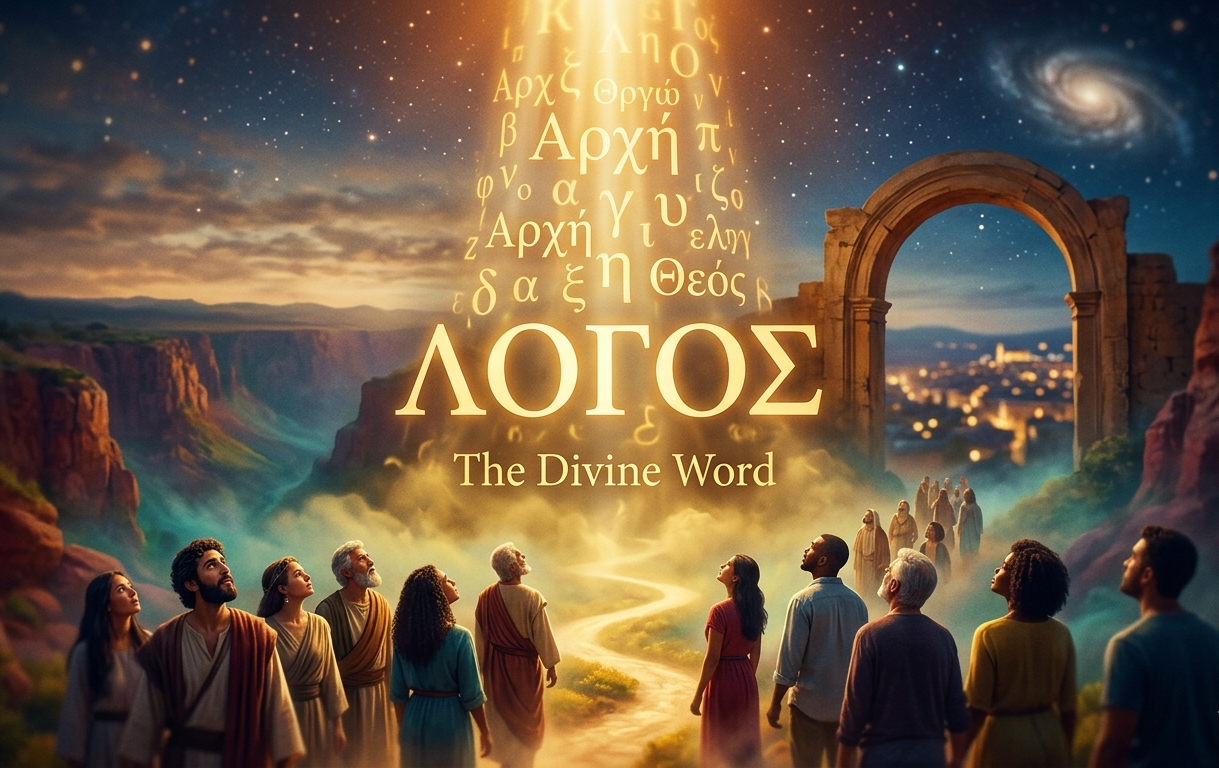
In the original Koine Greek of the New Testament, one of the most profound terms you will encounter is λόγος (logosLogos (λόγος): An ancient Greek term traditionally translated as "Word" in English Bibles (most famously in John 1:1). However, rather than just vocabulary or speech (which the Greeks called hremata), Logos refers to an ultimate organizing principle, supreme logic, dynamic creative power, and cosmic meaning. 📖 Want to dig deeper? Read our full analysis on how this single word bridges ancient philosophy, Jewish monotheism, and modern psychology: Beyond the English Translation: The Mind-Blowing True Meaning of Logos. More, pronounced loh-gahss). English Bibles almost universally translate logos as “Word”—most famously in the opening of the Gospel of John: “In the beginning was the Word…”
However, translating logos as a simple, spoken “word” is highly incomplete, and arguably limits its actual meaning. If ancient Greek writers simply wanted to refer to vocabulary, speech, or utterances, they had a much more accurate term for that: ῥήματα (hremataHrema (ῥῆμα): An ancient Greek term referring to an individual spoken word, a vocal utterance, a speech fragment, or a specific saying. Derived from the verb meaning "to speak", a hrema implies the operational, literal sound and direct breath of a spoken message (such as the specific words coming from the mouth of God in Matthew 4:4). It stands in contrast to Logos, which represents an overarching rational thought, cosmic grand design, or ultimate unified meaning. Plural: Hremata (ῥήματα). 🔄 Compare with Logos: Discover the critical theological differences between these two Greek terms in our full breakdown: Beyond the English Translation: The Mind-Blowing True Meaning of Logos. More).
By choosing logos, the New Testament writers weren’t just picking a synonym for speech. They were tapping into a profound concept of ultimate meaning, cosmic purpose, and—most importantly—the radical, undivided oneness of God celebrated in the ancient Jewish faith.
To truly understand Scripture, we must look past English translation limitations. We need to see how logos bridges ancient linguistics, the bedrock of Jewish monotheism, modern psychology, and humanity’s search for purpose.
The Lost Nuance: Logos vs. Hremata
To see why “Word” doesn’t quite fit logos, we have to compare it to hrema.
- Hremata (The Spoken Words): Hrema refers strictly to operational, sound-producing, individual words. It is an utterance, a plural collection of speech fragments, or specific sayings. When Jesus tells the devil that man lives by “every word (hrema) that comes from the mouth of God” (Matthew 4:4), it implies the literal voice and direct breath of a spoken message.
- Logos (The Underlying Meaning): Logos is not just the sound coming out of a mouth; it is the grand overarching thought, the logic, the rationale, and the grand design behind those words. While hremata are the scattered building blocks of speech, logos is the grand thesis statement of reality.
🧠 English Clues: Modern Words Born from Logos
If logos still feels a bit abstract, look at your everyday English vocabulary! We use the DNA of this ancient Greek word constantly to describe order, meaning, and identity:
- Logic: Derived directly from logos, “logic” is the study of correct reasoning and sound judgment. It represents an underlying order that makes sense of a chaotic argument.
- Logo: A graphic symbol used by a company. A good “logo” is not just a random drawing; it is a single visual emblem that encapsulates the entire identity, mission, value, and meaning of a brand.
- The “-ology” Suffix: Think of words like Biology (the study/logic of life), Psychology (the study/logic of the soul), or Theology (the study/logic of God). Whenever we add “-ology” to a word, we are looking for the rational structure and deep understanding of that subject.
When the Bible uses logos, it is combining all of these ideas: it is the ultimate logic of the universe, the definitive logo (representation) of God, and the supreme theology made visible.
The Power of the Singular: One Unified Truth
A vital grammatical detail often missed is that when referring to Christ or God’s ultimate message, logos is strictly used in the singular.
Human beings communicate using hremata—thousands of plural, fragmented words, sentences, and shifting arguments. Our thoughts are broken, scattered, and divided.
In contrast, God’s ultimate truth is not a collection of fragmented ideas. By keeping logos singular, the New Testament authors emphasize the absolute unity, consistency, and undivided nature of God’s being. God doesn’t have multiple competing philosophies, evolving messages, or internal conflicts. Put simply: God is entirely without cognitive dissonance. He has one singular Logos—a single, cohesive, harmonious plan that ties all of creation, history, and salvation together.
The Connection to the Shema: “God is One”
This emphasis on the singular logos perfectly mirrors the crown jewel of the Jewish faith: the ShemaShema (שְׁמַע): The literal Hebrew imperative meaning "Hear!" or "Listen!" In ancient Hebrew thought, shema implies far more than simply processing audio data; it means to listen with deep intellectual concentration and immediately respond with faithful, responsive action. Liturgically, the Shema refers to the crown jewel confession of the Jewish faith found in Deuteronomy 6:4: "Hear, O Israel: The Lord our God, the Lord is one." This declaration of radical monotheism serves as the central pledge of allegiance to the undivided nature of God. 🔗 See the Connection: Discover how the singular nature of Logos makes a direct, brilliant nod to the absolute oneness of the Shema: Beyond the English Translation: The Mind-Blowing True Meaning of Logos. More. Recited twice daily by devout Jews for millennia, Deuteronomy 6:4 declares: “Hear, O Israel: The Lord our God, the Lord is one.” (Hebrew: Shema Yisrael, Adonai Eloheinu, Adonai Echad).
The Hebrew word for “one” here is אֶחָד (echad). It doesn’t just mean a numerical “1”; it signifies a compound unity and an undivided nature. When the Old Testament was translated into the Greek Septuagint, this standard of absolute oneness became the bedrock for early biblical theology.
When John intentionally utilizes the singular Logos to introduce Jesus in John 1:1, he is making a brilliant, strategic nod to the Shema. He is signaling to his Jewish readers that Jesus is not a “second god,” an independent deity, or a fragmentation of the divine. Because Jesus is the singular, complete expression of the Father, He is perfectly aligned with the echad—the magnificent, indivisible oneness of God. The singular Logos underscores that the mind, plan, and essence of God remain completely unified from Genesis to the New Testament.
📜 Deep Dive: The Hebrew Roots of Logos
Long before John wrote his Gospel, Jewish scholars translated the Hebrew Old Testament into Greek (a version known as the Septuagint). When they encountered complex Hebrew concepts, they frequently chose logos as their umbrella term. However, just like modern English translations, this ancient translation sometimes flattened the unique Hebrew nuances:
- דָּבָר (Dabar): This is the primary Hebrew word translated as logos in the Old Testament. In Hebrew thought, a dabar is not a passive word on a page; it is a dynamic, active, event-producing action. When Genesis says “the word (dabar) of the Lord came to Abram,” it represents God’s creative energy breaking into our world. This carries the true weight and dynamic power of Logos.
- אִמְרָה (Imrah): Meaning an instruction, discourse, or poetic promise, this term emphasizes the specific, localized ways God speaks to us.
By using logos for both, ancient translators occasionally blurred the lines between the grand, creative decree (Dabar) and the localized speech (Imrah). Yet, through this linguistic bridge, they successfully transformed logos from an abstract Greek philosophical idea into a term overflowing with the active, powerful, personal presence of the God of Abraham.
Viktor Frankl: Logos as Humanity’s Ultimate “Why”
This distinction is precisely why psychiatrist and Holocaust survivor Viktor Frankl turned to logos—and not hrema—when naming his famous therapeutic framework: Logotherapy.
In his seminal book Man’s Search for Meaning, Frankl outlined that the primary driving force in human beings is a “will to meaning.” He explicitly bypassed the conversational definition of a “word” and anchored his therapy in the ancient Greek understanding of logos as meaning and purpose.
Frankl observed in the concentration camps that humans can survive almost any physical suffering if they have a logos—a defined, singular purpose, a reason to live, or an objective “why” to hold onto. For Frankl, logos was the spiritual framework of meaning that kept the human soul unified and alive amid chaos.
Logos in the Gospels: Meaning Personified
When we bring this distinction back to the most famous verse in the New Testament, the text completely shifts:
“In the beginning was the Logos, and the Logos was with God, and the Logos was God.” — John 1:1
If John meant that Jesus was simply a spoken announcement or a collection of teachings, he could have used hremata. But John chose the singular Logos intentionally to speak to two distinct audiences:
- To the Greek Philosophers: Logos was the invisible, rational, supreme organizing principle that kept the entire universe unified, orderly, and free of chaos.
- To the Jewish Minds: It tied back to the active, creative power of Dabar from the Old Testament scriptures, where God’s ultimate intent broke into the darkness to build life.
John’s radical, mind-blowing revelation is that the Logos—the cosmic order, the active Old Testament power, and the ultimate source of human meaning—is not an abstract philosophy, an invisible energy, or a psychological coping mechanism. He is a Living Being.
By declaring Jesus as the singular Logos, the Bible tells us that Jesus is the visible, walking, breathing manifestation of God’s entire inner thought and character. He is the ultimate, unified “Purpose” behind creation.
The Living Logos vs. The Letter That Kills
When we realize that God’s truth is a singular, cosmic reality, it alters how we read the pages of our Bibles. The scriptures themselves warn us against treating the Bible as merely a collection of static, disconnected rules. In 2 Corinthians 3:6, the Apostle Paul makes a jarring statement:
“…for the letter kills, but the Spirit gives life.”
When Paul talks about the “letter” (gramma in Greek), he is referring to external, written characters divorced from their divine purpose—commandments written on stone that human power alone tries to keep, which ultimately leads to spiritual death and condemnation. If we treat the Bible merely as a list of static rules, we are interacting with a dead “letter.”
In stark contrast, look at how the author of Hebrews describes the divine word:
“For the word (Logos) of God is alive and active. Sharper than any double-edged sword, [He] penetrates even to dividing soul and spirit, joints and marrow; He judges the thoughts and attitudes of the heart.” — Hebrews 4:12
Notice the word used here is Logos, not gramma (the letter) or hremata (individual utterances). The Logos is not a dead, stagnant text. He is alive and active. Because Jesus is the ultimate Logos, interacting with the Word of God is never about merely memorizing dead letters on a page. It is about a dynamic, meaningful encounter with a Living Being.
Where the fragmented letter brings death and legalism, the singular, living Logos pierces through our defenses, unifies our scattered souls, and gives us ultimate life.
More Than a Concept: A Reality to Live By
When you realize that logos means so much more than a printed “word,” your Bible study transforms. The individual verses we read on a page are the plural hremata—the specific spoken truths meant to guide us to the cosmic, singular, living Logos: Jesus Christ. He is the one who rescues us from the dead letter of legalism, anchors our existence, defines our purpose, and unifies our broken lives in a relationship with Him.
Admittedly, making this shift isn’t easy. Our modern culture has so thoroughly equated “Word” with ink on a page that letting go of that definition takes time. We can read the definitions, we can study the Greek, but moving from the rigid “letter” to the living “spirit” of the Logos is a journey of the heart. It takes time to truly “get it.” But once you do, the text comes alive.
How does changing your perspective from a dead “letter” to a living, unified “meaning of reality” change how you view your daily faith? Let us know in the comments!