
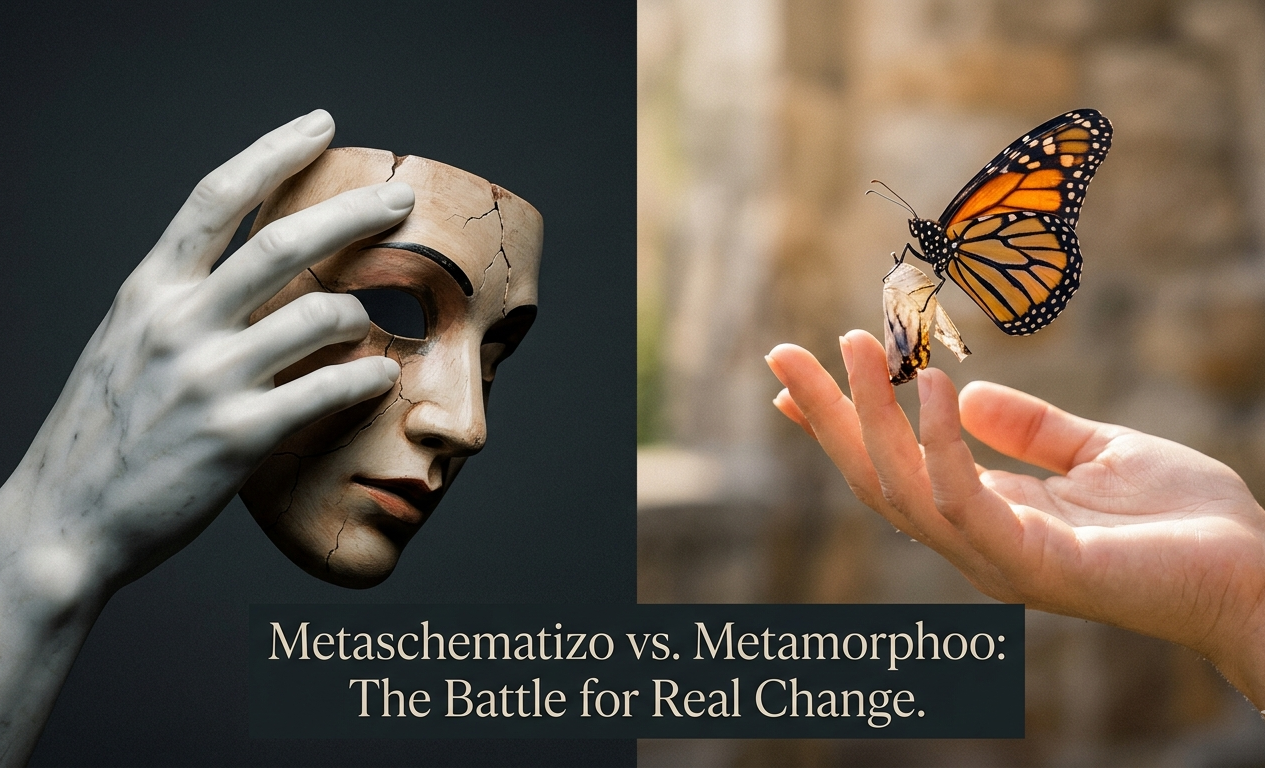
Beyond the Surface: How the Greek Prefix “Meta” Explodes Our Understanding of Transformation
When we read the word “repentanceMetanoia (μετάνοια): A compound noun formed by joining the prefix meta (signifying change, transition, or transcendence) and the root word nous (the mind or central seat of perception). While English Bibles traditionally translate metanoia as "repentance," the original text implies far more than emotional remorse, guilt, or behavioral modification. It represents a vertical shift—a structural renovation of the mind where the soul steps outside its old programming to look down neutrally and perceive reality clearly. It is the indispensable first step in the New Testament's chain reaction of transformation, dethroning the ego so true spiritual renewal can begin. 🔄 Deep Dive into Metanoia: Discover why true biblical transformation requires a linguistic shift from "feeling sorry" to an intellectual and spiritual reconfiguration of the soul: Beyond the Surface: How the Greek Prefix "Meta" Explodes Our Understanding of Transformation. More,” we think of guilt or behavior changes. But the original Greek text uses a word that explodes past those limits: Metanoia.
We live in a culture saturated with the word “metaMeta (μετά): A dynamic Koine Greek prefix that denotes a change of place, condition, or direction. It translates broadly to "after," "with," or "beyond." When attached to a root word to form a compound term, meta acts as an engine of transcendence, elevating or transitioning the base concept to a higher or altered state. For example, when applied to the mind (nous), it creates metanoia—elevating the mind to a higher, vertical vantage point where a person can objectively observe and reevaluate their own thoughts and actions. Ultimately, meta functions as a neutral mechanism in the New Testament, driving either a superficial, ego-driven masquerade of external performance (Metaschematizo) or an authentic, inside-out reconstruction of spiritual essence (Metamorphoo). 📖 Explore the Power of Meta: Discover how this single prefix exposes the human ego and unlocks the true, multi-step chain reaction of biblical transformation: Beyond the Surface: How the Greek Prefix "Meta" Explodes Our Understanding of Transformation. More.” From tech empires rebranding their corporate identities to movie plots that break the “fourth wall”—shattering the invisible boundary between the performance and the audience—we use “meta” to describe something operating on a higher, self-referential level.
But long before it became modern tech slang, μετά (meta) was one of the most explosive linguistic engines in the ancient Greek world.
In the original Koine Greek of the New Testament, meta functions as a prefix of radical alteration. It denotes a change of place, a shift of condition, or a relocation of direction. While it means to go with, after, or beyond, its spiritual movement is often less of a horizontal pivot and more of a vertical ascent.
Think of metadata—it is data about data, looking down from a higher level to make sense of the information below. In the exact same way, the New Testament uses meta words to describe a higher vantage point. It is the capacity of the soul to look down neutrally upon our own minds, hearts, and reactive habits. It is not a superior, “holier-than-thou” state of existence, but an objective observer’s view that frees us from being trapped inside our own behavior.
Unfortunately, when these dynamic compound words were translated into English Bibles, the connective tissue was completely severed. By translating Greek words like metanoia as “repentanceMetanoia (μετάνοια): A compound noun formed by joining the prefix meta (signifying change, transition, or transcendence) and the root word nous (the mind or central seat of perception). While English Bibles traditionally translate metanoia as "repentance," the original text implies far more than emotional remorse, guilt, or behavioral modification. It represents a vertical shift—a structural renovation of the mind where the soul steps outside its old programming to look down neutrally and perceive reality clearly. It is the indispensable first step in the New Testament's chain reaction of transformation, dethroning the ego so true spiritual renewal can begin. 🔄 Deep Dive into Metanoia: Discover why true biblical transformation requires a linguistic shift from "feeling sorry" to an intellectual and spiritual reconfiguration of the soul: Beyond the Surface: How the Greek Prefix "Meta" Explodes Our Understanding of Transformation. More,” metamorphoo as “transfiguration,” and metaschematizoMetaschematizo (μετασχηματίζω): A compound verb combining meta (change) and schema (the fleeting, temporary outward fashion or costume of a thing). It means to alter one's outward appearance, disguise oneself, or put on a superficial mask. This term represents the human ego's clever counterfeit of true spiritual growth—changing external behaviors or religious "personas" to look righteous while the inner character remains completely untouched. This is the structural mechanism behind what Jesus called a hypocrite (literally, "one who judges from under an actor's mask") and matches His description of a "whitewashed tomb"—beautiful on the outside, but unchanged within. 🎭 Unmask the Ego: Learn how to distinguish between the ego's behavior modification and the Spirit's deep-tissue renewal: Beyond the Surface: How the Greek Prefix "Meta" Explodes Our Understanding of Transformation. More as “disguise,” English translations leave us with seemingly isolated concepts. But in the original text, the prefix meta flashes like a warning light across all of them, revealing a hidden blueprint of how God relocates, alters, and shifts human reality.
The Two Tracks of Change: Mask vs. Essence
The engine of meta is entirely neutral. It simply means “change.” Because of this, the New Testament utilizes this prefix on two distinct tracks. The direction of the change depends entirely on whether the alteration is driven by the human Ego operating from the outside in (Negative), or by the Holy Spirit operating from the inside out (Positive).
To understand this distinction, we have to look at the fascinating relationship between two Greek compound words: Metaschematizo and Metamorphoo.
1. The Negative Track: Metaschematizo (The Personality Mask)
When the New Testament uses meta in a negative context, it describes a change that stays purely on the surface. It is a structural alteration engineered by the ego to simulate growth without actually changing the heart.
The primary word for this is μετασχηματίזω (metaschematizō). This word is a compound of the prefix meta (change) and the root word σχῆμα (schema). In Greek philosophy, schema refers to the fleeting, temporary, outward fashion of a thing—like a costume an actor wears on a stage.
This directly uncovers the true nature of a word Jesus used constantly to describe the religious elites of his day: hypocrites. In modern English, we think a hypocrite is just a liar, but the original Greek word ὑποκριτής (hypokritēs) has a much deeper etymology. It combines ὑπό (hypo, meaning “under”) and κρίνω (krinō, meaning “to judge or separate”).
A hypokritēs was a literal stage actor who held an oversized theatrical mask over their face, judging and speaking from underneath a mask. The actor projected a holy, dramatic character to the audience while their true self and hidden motives remained tucked safely away underneath.
🎭 The Psychology of the Persona
This is where we uncover a profound psychological intersection. The English word “personality” comes directly from the Latin word persona, which literally means a theatrical mask worn by ancient actors.
Psychologically, the human ego is a master mask-maker. It constructs an outer persona—a personality mask—to protect itself, impress others, and fit into religious or social circles. The ego loves behavior modification because it can change its outward schema to look righteous while its core values remain entirely unchanged.
Jesus exposed this exact ego-defense mechanism using a chilling visual anchor in Matthew 23:27:
“Woe to you, scribes and Pharisees, hypocrites! For you are like whitewashed tombs, which outwardly appear beautiful, but within are full of dead people’s bones and all uncleanness.”
This is the ultimate description of metaschematizo. The exterior is painted, decorated, and modified to look beautiful, but it is a change of clothing, not character. It is the ego shifting its appearance to look good while avoiding genuine internal accountability.
2. The Positive Track: Metamorphoo (The Essential Metamorphosis)
In stark contrast, when the New Testament uses meta positively, it describes a deep-tissue relocation of the soul. It doesn’t touch the superficial costume; it alters the fundamental identity from the inside out.
The primary word for this is μεταμορφφόω (metamorphoō), from which we get our English word metamorphosisMetamorphoo (μεταμορφφόω): A compound verb combining meta (change/beyond) and morphe (the essential, unchangeable nature of a thing). Unlike external behavior modification, metamorphoo represents a fundamental inner transformation—an organic change of essence from the inside out (the root of the English word metamorphosis). It is the ultimate fruit of a renewed mind, used to describe Christ's divine nature breaking through His physical skin at the Transfiguration (Matthew 17:2). It stands in direct opposition to metaschematizo (the outward performance mask). 🦋 Explore the Essence: Read our full analysis on how the Holy Spirit bypasses outward costumes to structurally rebuild your true identity: Beyond the Surface: How the Greek Prefix "Meta" Explodes Our Understanding of Transformation. More. This is a compound of meta (change) and μορφή (morphe). Unlike schema (the temporary costume), morphe refers to the unchangeable, essential, underlying nature of a thing. A caterpillar doesn’t put on a butterfly costume; it undergoes a total biological reconstruction to become a butterfly.
This track perfectly mirrors Jesus’ simple instructions for genuine spiritual health in Matthew 23:26:
“You blind Pharisee! First clean the inside of the cup and the plate, that the outside also may be clean.”
How the Bible Uses It:
This is the exact word used when Jesus takes Peter, James, and John up onto a high mountain:
“And he was transfigured (metamorphoo) before them, and his face shone like the sun, and his clothes became white as light.” — Matthew 17:2
Jesus didn’t put on a mask. His outward appearance changed drastically because His internal divine reality was bursting outward. This sets up the ultimate command for the believer in Romans 12:2:
“Do not conform to the pattern of this world, but be transformed (metamorphoo) by the renewing of your mind…”
Paul is drawing a definitive line in the sand. He is telling us: Stop playing the ego’s game of shifting your outward costumes (schema). Instead, allow the Spirit to fundamentally alter your actual essence (morphe).
The War of the Prefix
| The Ego’s Counterfeit (Negative) | The Spirit’s Reality (Positive) |
|---|---|
| Metaschematizo | Metamorphoo |
| Changes the Mask (Schema) | Changes the Essence (Morphe) |
| Engineered by the Ego | Engineered by the Spirit |
| Superficial Behavior Modification | Permanent Identity Reconstruction |
| Impresses people externally | Realigns the soul internally |
The Gateway of Change: The Three-Step Chain Reaction
If our ultimate goal is metamorphoo—genuine, inside-out transformation—how do we trigger it? How do we break past the ego’s personality mask?
The New Testament provides a direct answer, but it requires tracing a brilliant, sequential chain reaction driven by three distinct meta compounds. When we look at them together, they map out the complete journey from an invisible thought to an active lifestyle pivot, and finally to a total essential reconstruction.
Step 1: Metanoia (The Shift of the Mind)
The indispensable gateway of this process is trapped behind one of the most misunderstood words in the English language: Repentance.
In our modern religious culture, “repentance” carries heavy emotional baggage. It is heavily tied to a Latin root meaning regret, sorrow, penance, or self-punishment. We have been conditioned to believe that to repent means to feel utterly miserable about our flaws, cry tears of remorse, and promise to behave better. But emotional remorse belongs to the realm of the outward mask (schema). You can cry tears of regret without ever altering your core reality.
Worse yet, many religious circles reduce repentance purely to a “change of action”—putting away sinful activities and performing righteous deeds. They point to these modified behaviors as absolute proof of a righteous person, completely ignoring the fact that what is on the inside remains unexamined. This is simply swapping a worldly mask for a religious mask. It is still just metaschematizo.
In the original Greek text, the word is μετάνοια (metanoia). This is a compound of our prefix meta (change/beyond) and nous (the mind or central seat of perception). Literally translated, metanoia is a mind-shift. It is that vertical vantage point where the mind steps outside its own programming to perceive its own thoughts, heart, and actions from above. It is a structural renovation of how you process reality. To experience metanoia means that your old, ego-driven way of thinking is dethroned, allowing you to see truth, God, and yourself clearly for the very first time.
Step 2: Metaballō (The Pivot of Trajectory)
Once your mindset has been radically altered, it triggers the missing dynamic link: μεταβάλλω (metaballō).
This word is a compound of meta (change) and the root verb βάλλω (ballō), which means to throw, cast, or propel something. Literally, metaballō means to aggressively throw your trajectoryMetaballo (μεταβάλλω): A compound verb combining meta (change/transfer) and the root verb ballo (to throw, cast, or propel). Literally meaning to aggressively throw one's trajectory into an entirely new direction, metaballo serves as the critical, dynamic bridge between an internal shift of the mind (metanoia) and a permanent transformation of essence (metamorphoo). It is the transitional pivot where an updated worldview actively propels an individual to cast off old behaviors and physically redirect their daily lifestyle choices toward the Logos. 🔗 See the Connection: Trace the exact 3-step chain reaction from thought, to trajectory, to transformation: Beyond the Surface: How the Greek Prefix "Meta" Explodes Our Understanding of Transformation. More into a completely new direction. It is the transitional pivot.
You do not experience metanoia and simply sit still with new thoughts. A genuinely relocated mind (metanoia) naturally propels you into a relocated lifestyle (metaballō). It is the moment your physical actions, habits, and daily choices are actively thrown off the path of the ego and cast onto the path of the LogosLogos (λόγος): An ancient Greek term traditionally translated as "Word" in English Bibles (most famously in John 1:1). However, rather than just vocabulary or speech (which the Greeks called hremata), Logos refers to an ultimate organizing principle, supreme logic, dynamic creative power, and cosmic meaning. 📖 Want to dig deeper? Read our full analysis on how this single word bridges ancient philosophy, Jewish monotheism, and modern psychology: Beyond the English Translation: The Mind-Blowing True Meaning of Logos. More.
Step 3: Metamorphoo (The Transformation of Essence)
When metanoia alters your internal root, and metaballō alters your external direction, it inevitably produces the ultimate fruit: μεταμορφφόω (metamorphoō).
As you consistently walk in the new direction of metaballō, the Holy Spirit begins a full-scale spiritual metamorphosis of your morphe—your underlying, essential nature. You are no longer just changing your behavior or modifying your outward costume; you are being completely reconstructed from the inside out to reflect the very likeness of Christ.
Moving Beyond the Dead Letter
When we lift the veil of English translations and reconnect these meta compounds, the entire spiritual landscape of the Bible shifts.
We begin to see that human thoughts are naturally fragmented, constantly trying to construct a holy-looking persona to hide our brokenness. But God has no interest in our metaschematizo—He doesn’t want us to manage our behavior, perfect our masks, or memorize a list of static rules. That is a dead letter.
Instead, He invites us into a dynamic relationship with the living Logos. Through the power of metanoia, He shatters our psychological defense mechanisms, alters our mindsets, and initiates a profound metamorphosis that changes us from the inside out.
Spiritual growth is never about trying harder to wear a religious mask. It is about allowing the engine of meta to relocate your entire soul.
Live the Reality
Untangling ourselves from the ego’s personality mask is a daily journey. Our culture values the outward display, but God looks directly at the underlying reality.
How does realizing that “repentance” is a structural shift of your mind—rather than just an emotional feeling of guilt or a superficial change of habits—change how you approach your relationship with God today? Let us know in the comments below!